Tuesday, June 28, 2016

The Great Gun Debate, Part II

Wow, my last post about guns is right at 199 views right now!

For reference, the most views I've had on a single post before this week was about 50, so that's pretty fun for me.

Surprisingly for me, other than a lot of people sharing the article, I didn't get much feedback. There was one note about the article that a friend of mine told me about that had a couple of good points, and they helped me to frame what I wanted to say.

Two points to follow up on:
1. What about permitting and training?
2. How do not turn this into an arms race?

For both points, the questions resonated with me as "where do we draw the line?" And I'll get back to that in minute.

To the first idea:

Permitting and Training

I have always been a huge supporter of gun training. I've known too many people who suddenly feel the force disparity in their own lives, buy a gun, and go through one box of ammo at the range, only to leave the gun somewhere in their bedroom, or even worse, their car, thinking that if things go wrong you can just "pull the trigger" and the bad things go away.

This is a spectacularly bad plan.

If this you right now, go give all your ammo to your friend and lock up your gun until you learn to use it right. And I'm not talking about slow, controlled fire into a paper target 6 feet away. (If you bought a gun solely to use to punch holes in targets from whatever distance, carry on and enjoy.)

First, train the gun safety rules.
Some systems use 4 rules, I like the 3 step system, it's easier to keep track of 3 rules.

1. Assume every gun is loaded.
2. Keep your finger off the trigger until you are ready to fire.
3. Don't point the gun at anything you are not willing to destroy.

Train with it. For starters, check with someone who knows, but see what it takes to safely dry-fire your gun. For the dry-fire exercise, keep the 3 rules above.

Dry fire your gun at least 100 times to start with. Before you go to the next live-fire practice, dry-fire your gun 10 times for each live round to are planning to shoot.

Dry fire your gun from a sitting position, from a standing position, while walking (forward, backward, side to side). Dry fire while leaning around a corner. Get creative but stay safe.

When you actually go shoot, practice more that just firing the gun. Practice what will help you actually use the weapon,but stay safe! There are a ton of good resources out there to help you.

But take responsibility for the tremendous power you have brought into your life and PRACTICE!

You're never done practicing.

Also, get your head straight. Killing someone (even in a justifiable defense) still can screw up your head if you're not prepared for it. (Actually, it can screw you sometimes even if your are prepared for it.)

Now about permitting.

I am fine with the permitting system that is in place now for most states. I would be unhappy to live in California, because they probably wouldn't permit me, but I'm not going to scream about my 2nd amendment rights there.

I have taken 3 concealed carry permit classes for 2 different states, and I'm about to take a fourth. They're great. I'm fine with requiring a permit to carry a concealed pistol for self defense. Even if you don't really plan to go around armed, take the class anyway.

Most of what you will learn there is related to the laws of self-defense for your state.
And no, you don't need to register your hands as "deadly weapons" if you have a black belt.

I'm not getting into it here, but Massad Ayoob is widely recognized for his work in shaping use-of-force laws. You can get the basic rundown on one page here: https://www.useofforce.us/3aojp/

Most states have a variation of the AOJP checklist to determine if you are justified in using deadly force.
A: Ability - does your attacker have the ability and force (or force multiplier) necessary to harm you.
O: Opportunity - are they actually in a position to hurt you? This is where the gun vs. knife drill is useful -- a man with a knife in hand is a threat to you if he charges you from less that 25 feet away and you have a gun.
J: Jeopardy (Imminent Jeopardy) - Is the threat immediate? Just because a large man who is a black belt is standing next to you on a street corner (ability and opportunity) doesn't mean he's going to attack you (Jeopardy.)
P: Preclusion - Have you precluded (ruled out) all other options? Could you give the mugger your wallet and run away? Is it safe to retreat? Are there dependents with you? Etc. What about just buying the angry guy a beer and apologizing?

Different states draw a line at different places for each of these conditions. In one state, you can use deadly force to prevent a "felonious assault" on yourself or another person. (Kidnapping, rape, assault, etc.) Another state says that you can use deadly force to protect your property, and even that of your neighbor! Different states have different lines for preclusion - how hard to you have to try to retreat? Find out where your state stands.

This is NOT a comprehensive explanation, it's just there to get you interested in learning more on your own.
Start here:
https://www.useofforce.us/3aojp/

Get permitted. Pass the background checks. Don't worry about it.

I AM opposed to a national gun registry though. If certain weapons get banned, I'm not happy with the idea that the Fed. Govt. knows exactly how many of what kind of gun I own.

Now, on to the second point, before this gets too long.

How do we prevent the private arms race from accelerating?

Where do we draw the line? Muskets, revolvers, pistols, rifles, bazookas, tanks?

Let me introduce you to an interesting license:

The class III license.

In order to use a weapon that is listed below, you must have a special permit called a class III permit.
I thought about getting one to buy a silencer - I might still do it someday.

From the  of Bureau of Alcohol, Tobacco, Firearms and Explosives: (ATF)
https://www.atf.gov/firearms/qa/what-firearms-are-regulated-under-nfa

What firearms are regulated under the NFA?

(1) a shotgun having a barrel or barrels of less than 18 inches in length;
(2) a weapon made from a shotgun if such weapon as modified has an overall length of less than 26 inches or a barrel or barrels of less than 18 inches in length;
(3) a rifle having a barrel or barrels of less than 16 inches in length;
(4) a weapon made from a rifle if such weapon as modified has an overall length of less than 26 inches or a barrel or barrels of less than 16 inches in length;
(5) any other weapon, as define in subsection (e);
(6) a machinegun;
(7) any silencer (as defined in section 921 of title 18, United States Code); and
(8) a destructive device.
[26 U.S.C. 5845; 27 CFR 479.11]


I know there are some people who are tying to get silencers off this list. Other than that, it's a pretty non-controversial list.

You'll notice that machineguns require a special permit. So do "destructive devices." This basically covers explosives. (That would include the ubiquitous bazooka or rocket propelled grenade [RPG] in the arms race question.)

So far as I know, the NRA or "Gun Nuts" aren't too concerned with this list. It's not a big issue. You want one of the items on this list -- you gotta jump through some serious government red-tape hoops to get them. Most people don't want anything on the list badly enough to get them.

By the way, if you do buy a Class III weapon, it does go on a national registry.

That's your arms race limit. You can go as high as you want until you hit Class III.
You can even buy your own tank! But the gun on the tank is a "destructive device" so you have to talk to the ATF about firing it. Most privately owned tanks have the gun permanently disabled.

I've met people who think an AR-15 is a machine gun. It's not. It's a big source of confusion because it looks like this:
(From wikipedia)

Those are M-16s of different models. These are machine guns and heavily regulated as a Class III weapon.

That's an AR-15. It's not a machinegun, and is not regulated as a Class III weapon.
Can you tell the difference by looking? 

I can't.

It's what goes on inside the gun that makes a difference. 
I'll try to take this slow, because it can get confusing.
You have basic designations for how a gun cycles -- that means how it loads the next round and prepares to fire.
Starting at the bottom:

  • Muzzleloader -- old-school muskets -- you pour the powder and ram the bullet into place from the dangerous end of the the gun. (rifles, pistols, shotguns)
  • Breach-loader -- old school rifles -- you load one round at a time through an opening (using a gate or lever).
  • Single-action - two types
    • Revolvers - you have to manually cock the trigger back to rotate the live round into place to be ready to fire. The old cowboy pistols. The Colt Peacemaker (Colt Single Action Army) is probably the most famous.
    • Rifles and shotguns - either using a pump action, a lever action, or a bolt action, you manually remove the empty case and load a new round by working the action. This also cocks the hammer. Each time you fire a round you have to work the action once. Most hunting rifles and shotguns work this way. Examples include the Winchester94 (lever action rifle),  Remington 870 (pump action shotgun), M1917 Enfield, (bolt action rifle).
  • Double action
    • Revolvers - one long pull on the trigger performs the "double" actions of pulling back the hammer and dropping it, rotating a new round into place for firing. End result - one trigger pull, one bullet comes out. Repeat as necessary. No safeties included. This type of pistol was popular with police for it's simplicity. The Colt Trooper and the Smith and Wesson .38 (Model 10) are icons of this type. 
  • Double-action only
    • This one's confusing, but important. It's a mix of the double action and semi-automatic. It's automatic in the method used to eject the old case and load a new shell, but in order to fire it, you have the long trigger pull of the double-action that cocks and drops the hammer in one smooth motion. This removes the hair-trigger of the semi-automatic and makes the pistol safer. DOA is also known as a "safe-action" pistol. The most famous is the Glock style pistols used by many police departments in the US.

  • Semi-automatic
    •  The "Automatic" refers the method of loading the new shell. You manually load the first one and cock the trigger, but the force from the pressure that pushes the bullet out also is used to remove the empty case and automatically load a new one.
    • This gets confusing, because the "semi-automatic" pistol released in 1911, (called the 1911 because at lease something has to be simple) is known as a .45 Auto. 
    • Each time you pull the trigger, one bullet comes out. To fire again, you have to release the trigger completely and pull again. That's what defines the "semi" part of the semi-automatic.
    • Famous examples include most guns used during WWII - the 1911 pistol, the Luger German pistol, the famous M1 Garand of WWII, and later the controversial AR-15.
  • Fully Automatic
    • This is a machinegun. Early full-autos kept loading and firing bullets until you released the trigger or ran out of ammo. Later models have an option to only fire 3 bullets, then stop until you release the trigger and pull it again. This is to increase accuracy and waste less ammo. 
    • As discussed above, this type is heavily regulated as a Class III weapon. This is what you'll see in most action movies and TV shows. The Tommy-gun, the AK-47, the Uzi, and the M-16 are famous fully automatic weapons.
So to answer the question - once you hit a certain type of weapon, whether it's a grenade launcher or a machine gun you have to get a special permit to obtain it, and pretty much everyone I know is okay with that.

Thanks for sticking around this long -- remember I promised I would talk about: 

"Where to draw the line?"

Well here we go.
Most people have a pretty common set of beliefs as far as what's acceptable and what isn't. We're fighting over a pretty thin line. What do I mean?

Well, right now the line people are fighting over is somewhere in the middle of the semi-automatic rifle category. 

Most people in the US are really pretty OK with Single action and double action guns. A large majority is OK with semi automatic handguns. And if fact, if you include a lot of older style semi-automatic rifles and shotguns, many people are fine with them too.

The fight right now is over such fine details as how many rounds can a magazine hold, and whether a pistol grip is more dangerous than an old fashioned rifle grip. We're arguing over whether the front stock can go all the way around the barrel (a barrel shroud), or if it can only cover the bottom portion.

Most people also agree that machineguns and explosives should be heavily regulated. 

At the end of the day, we're not that far apart on what we're willing to accept as a society. We're really pretty much in agreement. It's just the fine details we're fighting over. 

I'd say we're actually doing pretty well.


Sunday, June 26, 2016

The simple problem regarding gun ownership. It's not about the children.

First, I want to get past some of the more often repeated pro and anti gun arguments based on statistics.

Statistically speaking, are you more or less safe with a gun in your house. The answer is:
It depends.

Every statistic that I've seen can be countered with another. A specific study on one type of situation has another one that has the opposite results in a different specific situation.

It seems at the end of the day, there is no statistical proof that either owning or not owning guns is safer overall. There are simply too many variables with too many agendas at this point to get a clear study.

So if you want to debate whether or not Australia or Austria is safer because of their gun laws, and how we should copy their laws into the U.S., that's for another site.

Moving on.

"But what about the children?" Children die from guns. That's true.

You know what more children die from? Drowning.


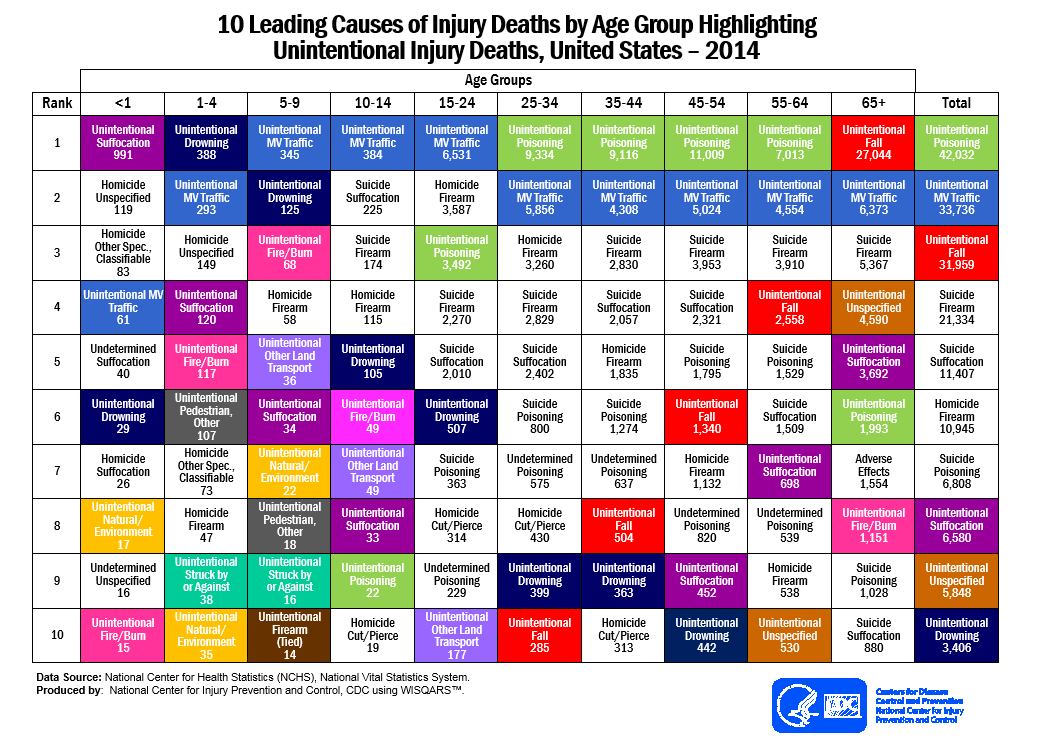
According to this chart, 647 Children aged 1-14 died from drowning in 2014 in the U.S.

For the same age group, 220 died by firearm homicide. 174 died from firearm suicide, and 14 died from unintentional firearm.

This is also interesting:

"Minorities: Between 1999-2010, the fatal unintentional drowning rate for African Americans was significantly higher than that of whites across all ages. The disparity is widest among children 5-18 years old. The disparity is most pronounced in swimming pools; African American children 5-19 drown in swimming pools at rates 5.5 times higher than those of whites. This disparity is greatest among those 11-12 years where African Americans drown in swimming pools at rates 10 times those of whites."
http://www.cdc.gov/homeandrecreationalsafety/water-safety/waterinjuries-factsheet.html

So of the 647 children that drowned in 2014, the astonishing majority of them are African American? Where's Obama's outrage over them? What if Trayvon Martin had drowned?

If it's just about protecting the children or protecting minorities, why do we not have stricter pool ownership and swimming protection laws? Why do we not require permits and licenses to own your own pool? Shouldn't you be required to take lifeguard training before being allowed to own a pool?

Shouldn't hotels and recreation centers require certified lifeguards to be on duty any time the pool is accessible? Do you know how many children would be saved each year? If it's really about saving children, why are people not upset about the dangers of drowning?

Owning a swimming pool is not in the bill of rights. Laws could be easily passed that don't infringe on our right to swim.

But it's not about saving the children. It never really was.

It's about disparity of force.

Firearms are an extreme example of what's known in martial arts as a "force-multiplier." 
In common terms, it's a strength equalizer. 
Weapons are designed to maximize a person's strength to cause damage. A physically weak person with a club can hit harder than a strong person with a fist. Using leverage it multiplies the force to a greater amount. A spear or a knife takes the force and condenses it into a small cross section, effectively multiplying the force of the strike.

A gun takes a couple of pounds of pressure on the trigger to release several hundreds of ft-lbs of energy.

A 9mm pistol releases about 383 ft lbs.
A .357 magnum revolver releases about 640.
A .223 (What AR-15s shoot) is about 1,300.
A hunting rifle is between 1,300 and about 5,000.

Most anybody is strong enough to pull a trigger.

At a basic, almost primitive, level we don't like the idea of other people possessing more power than we do.

Swimming pools don't do that. They aren't force multipliers.
Swimming activities don't trigger that basic fear of allowing someone else to possess that kind of force over us.

Swimming is just fun that can be dangerous.

Someone else with a gun has more physical force at their disposal than we do.

So we have two simple solutions to the force disparity. (or you choose nothing)

Someone else has a gun. You either.

A.) Take their gun away.
B.) Posses your own gun.

Let's be honest about what it is we're fighting over with this gun debate.

It's not about the children. If it were, you would see the same amount of effort put into preventing drownings as you do with regulating guns.

It's not about fighting terrorism. Your average Israeli population is armed to the teeth. They still fear terrorism.

It's about how do choose to deal with the primitive fear of knowing that someone near you possesses more physical force than you do.

If I choose A, then I make the decision to take the gun away from those who chose B.
If I choose B, then I become a threat to someone who chooses A.

That's what we're fighting over.

Choosing A is an impossible situation. I would have to take everyone's guns away when they don't want me to.

I choose B and take responsibility.


Wednesday, June 22, 2016

This Title is a Paradox.

Life is full of paradoxes. And that's awesome.

Last week I wrote about Algorithms, and how they can be used to master skills that can be used every day. Today I'm talking about the opposite end of logic and reason.

par·a·dox
ˈperəˌdäks/
noun
  1. a statement or proposition that, despite sound (or apparently sound) reasoning from acceptable premises, leads to a conclusion that seems senseless, logically unacceptable, or self-contradictory.
    "a potentially serious conflict between quantum mechanics and the general theory of relativity known as the information paradox"
    • a seemingly absurd or self-contradictory statement or proposition that when investigated or explained may prove to be well founded or true.
      "in a paradox, he has discovered that stepping back from his job has increased the rewards he gleans from it"
      synonyms:contradiction, contradiction in terms, self-contradictioninconsistencyincongruity;More
    • a situation, person, or thing that combines contradictory features or qualities.
      "the mingling of deciduous trees with elements of desert flora forms a fascinating ecological paradox"

A paradox works both ways: A seemingly logical situation that ends up appearing absurd when you look "deeper", or a seemingly illogical or absurd statement that ends up making sense when examined closely. Sometimes both at the same time (which is in and of itself a paradox.)

One of the most easily recognized paradoxes used in fiction is the time-traveler's paradox. It works out in many ways.

In the Terminator storyline John Connor sends Kyle Reese back in time to protect his mother before John is born. Kyle ends up becoming John's father.

Would John Connor have existed if he had not sent Kyle back in time?

Variations include going back in time to give Shakespeare a full copy of his published writings before he wrote them, or going back in time to stop an event, which if successful renders the need to go back in time irrelevant, meaning the time traveler does not go back in time, which means the event ends up happening, prompting the traveler to go back in time to fix it . . . etc.

M.C. Escher based his career off of paradoxical drawings.
http://www.mcescher.com/

Bach even wrote a canon called the "endlessly rising canon" which is a musical paradox. (http://mathworld.wolfram.com/StrangeLoop.html)

In real-life science, paradoxes are a part of quantum mechanics every day. They've been shown to be so consistent that computer chips and cell phones are designed around them, but yet they have never been resolved. They are still being studied, but the results are accepted and used.

Schrodinger's Cat is probably the most famous (if most misunderstood) quantum mechanics paradox. The most intriguing to me is the wave-particle paradox. The famous double-slit experiment and the experiments it inspired produce a whole host of paradoxes, including a scientific reexamination of the time-traveler's paradox referenced above!

If you want to really stretch your brain, look up explanations of the half-integer-spin particles called "fermions."  (http://hyperphysics.phy-astr.gsu.edu/hbase/particles/spinc.html). We all know about electrons, protons and neutrons, right?  If you spin any one of those particles 360 degrees, they won't look the same. You have to spin them twice (720 degrees) before they end up back where they started. All atoms are made up of fermions which are physical paradoxes. You are made up of atoms. Everything is. You are a walking paradox.

You are a logical contradiction.

Light is simultaneously an energy wave, and a bunch of particles. Not part wave and part particle, but it behaves with properties of both waves and particles at the same time.

Time doesn't travel in they way we think it does, it is relative to your perspective. Einstein's E=mc^2 is the mathematical formula representing the paradoxical nature of time.

In fact, most things we accept as "true" are paradoxes.

So science, philosophy, art, music, and even common sense rely on paradoxes to function.

God is a paradox. Why do people who base so many beliefs on science, knowing it's full of paradoxes, dismiss the idea of God simply because the idea of an all-powerful God is paradoxical?

Some would say that the concept of God is "self-contradictory" and so it is illogical, but how is that different from a paradox?

"Can God make a rock so big he can't move it?" That's not an illogical question -- that's a paradox.

People say "the Bible is full of contradictions." Is it? Then why do so many scholars throughout history (who can plainly distinguish contradictions) say it's not? Is it just that the Bible is full of paradoxes?

The very concept of a Bible (a series of books inspired by God, but written by men, over the course of thousands of years to write a single story) is a paradox. If God wrote it, shouldn't it be perfect? But if men wrote it, it can contain imperfections (estimates instead of actual numbers, discrepancies in geographical descriptions, translation issues, etc.) Yet the imperfections are a testament to the authenticity of the process of the writing.

If it was too perfect, we would dismiss it as a forgery by just a small group of people, but if it's not perfect, we dismiss it as being made up by a small group of people, not God.

The very idea of a Bible is a paradox.

If God knows everything, does he know the future? If he does, can the future change? Am I a robot, or do I truly have free will?

These are all paradoxes. And by being wonderful paradoxes, they have great company in science, art, math, music, and philosophy.


Sunday, June 19, 2016

Happy Fathers day to all the Men out there!

Happy Father's Day.


Sarah posted a good comment on my post about raising girls to be strong. She said: "In certain ways I think that the "ideal" for men is much more restrictive than the ones for females. We as women are free to choose between several different "ideals" that makes it both freeing and more difficult."

She has a good point, and one that I was reminded of today at church.

Yet another study on how fathers are to be "strong" and "courageous." 

Be a good example. Protect your family. Don't exasperate your kids. Discipline your kids. So it goes . . .

In other words: Fathers: be MEN!

What does that really mean? "I am Manly!"

Don't lose your "Man Card." 

Facebook recommend I join a "Real Men"  type group yesterday, apparently because I'm a man. What was it? Guns and degrading pictures of women. Yeah, that's us. Weapons and lusting over women.

By "Manly" do we mean full of testosterone? I think that's the end of the definition as far as society goes.
What does testosterone do?
Obviously it promotes muscle growth and changes in your body, but it also changes your thinking.

Testosterone increases motivation, competitiveness, stamina, sexual arousal, risk taking behavior, aggression,  and "mating behavior." (from Wikipedia.)

So a "Man" is someone with high testosterone levels? That sounds more like a teenage boy to me.

Testosterone begins to drop as men grow older -- you know, like when they become FATHERS. 

If they don't, statistically you have issues:
"We examine the relationship of testosterone to tendencies to marry and divorce, and to the quality of marriage, of a large representative sample of men. The analysis shows that men producing more testosterone are less likely to marry and more likely to divorce. Once married they are more likely to leave home because of troubled marital relations, extramarital sex, hitting or throwing things at their spouses, and experiencing a lower quality of marital interaction. Sociological models that might be informed by this finding are examined, and its implications for subsequent research are discussed.

Yeah, let's celebrate that. (Not.)

I would rather celebrate those men who have matured past adolescence and learned to do well in the world regardless of their hormonal level. Let's celebrate men who respect their wives, children, and honestly everyone who has less testosterone.

Let's (as a society) actually honor and hold up the men who aren't defined by the chemicals in their system. Let's redefine "Manly" as those who have moved beyond their teenage habits. Let's set that example for our sons and daughters.

So, here's my "Manly" art work that I enjoyed doing because I love my family.

Happy Father's day!


Wednesday, June 15, 2016

How a Rubik's cube changed my life

Algorithms.

al·go·rithm
ˈalɡəˌriT͟Həm/
noun
  1. a process or set of rules to be followed in calculations or other problem-solving operations, especially by a computer.
    "a basic algorithm for division"


It seems to me that most problems in life can be solved by applying the right algorithm. Many skills can be taught in the first phase (knowledge) by algorithms. 

The algorithms alone can't make you good at something, or life in general, but they can start you on a path to success. In order to be effective, they need to be practiced.

I learned this from a Rubik's cube.

It's a useless little puzzle. It's accomplishes nothing. It's not artistic, it doesn't teach an ethical or moral lesson, as some games do. When complete it's just a boring six-sided cube with different colors. but it taught me so much!

The Rubik's cube has earned a reputation as a genius's puzzle. One must be very smart (apparently) to solve a cube. Stories say that it took the inventor himself a month to solve it. But there's a not-very-well kept secret: you solve it using predefined algorithms. He did't solve it in a month -- he spent a month developing algorithms.

What is an algorithm? On a cube, it's the order that you twist different sides to move the blocks to where you want them. One way to solve it is in six different "steps" with each step using one unique algorithm, or sequence of moves.

You perform each algorithm for the step until the cube looks like what you want to achieve, then you move on to the next step. Then you repeat each step and eventually the problem is solved. It's not a terrible mystery, it's just that people who can solve the cube have spent time learning and practicing those algorithms in order until they apply them from memory.

A seemingly impossible problem get solved within minutes.

Pick a hobby. Let's say Scuba Diving.

Lots of fun, amazing scenery, all kinds of options, but dangerous.

You need to be certified to dive. You need training. Scuba isn't inherently dangerous, it's just extremely unforgiving, so instructors teach you to do tasks in a certain order so nothing critical is forgotten.

A complicated life-support system is simplified for easier understanding. Air hoses and regulators are on the right, support information is on the left.

Emergency procedures are broken down in to basic steps in order (algorithms) and drilled in a swimming pool until they are understood.

The dive itself is planned out, with bottom times and depths calculated, rates of ascension and breaks between dives are mapped out on a chart, or using a portable computer.

Breaking down and cleaning the equipment is done the same way every time so the next dive is predictable.

You wan't to learn to Scuba dive? learn the Scuba diving algorithms and practice them.

Let's go to the opposite end -- art!

You can't apply something as boring as algorithms to art can you? Of course you can!

Pencil drawings are done in steps. Rough outlines, shapes and layout are done first, then shading is added for depth, finally details are filled in. Each step has an appropriate algorithm.

Drawing faces has an algorithm, horses and dogs do too. Buildings, roads, and walls have their own perspective algorithms.

Dancing? Same thing. Basic steps, foundations, movement, etc. Unique algorithms for unique dance styles.

Martial arts? Check. Combination attacks, strategies, etc.

Flying was revolutionized with the B-17 by developing checklists -- piloting algorithms.
http://www.atchistory.org/History/checklst.htm

The more you practice these algorithms, the better you will be at applying them in unique situations.

And if you say you can't learn these skills -- that you can't have formal education, or you're not capable?

Then I say you're wrong because you're reading and comprehending this blog well enough to form an argument against it.

Not only is language made up of the most complex algorithms with English leading the way in terms of exceptions, oddities, and rules, but you're READING it!

And, to really make it crazy, you learned this as a child!

If you can learn to navigate language as a child, with no formal teaching, you can learn anything.

What if you could apply this thinking to every problem in your life?

Sunday, June 12, 2016

Shooting at a gay bar killed about 50 people.

First, NO ONE deserves to be killed for their beliefs or orientation, I don't care what your stance is.

Second, I want to be very careful to respect the dead, their families, and friends. So if I word this wrong, please read it to err towards respect to all the victims of the shooting.

But I'm sick of the cycle. This type of thing gets repeated over and over again. For what the shooters are trying to do, this type of attack has been shown to be very effective, and so it will continue.

Right now all kinds are people are hurt, angry, scared, and they are saying what we should do to stop this sort of thing from happening ever again.

The same people are making the same arguments.

"If only we had banned assault rifles."

"If only someone there has had a gun."

"If only we were more accepting of gays."

"If only we were harder on terrorism."

If only . . . If only . . . if only?

We're hardwired as a species to make order out of chaos. We're wired to find a pattern in a random pattern. It's how we survived predators. It's primal and intuitive.

The hunter-gatherer who saw the face of a predator in the shadows was more cautious -- even if it was a false alarm. The one who wasn't looking for patterns missed the predator in camouflage and got eaten.

But now in a situation like this we get scared, hurt, and angry, and our primitive brains seize onto a simple solution that helps us feel better and sleep at night in a big scary world.

None of the knee-jerk reactions we're about to see in the news, none of the 140 character pearls of wisdom that we'll be pelted with on Facebook, none on the tired old cliches that will be recycled as though they just needed to be repeated one more time will make a lick of difference.

The truth is - that we cannot predict and control every outcome. The world is too big and has too many evil people in it to do that.

Like a toddler, when something like this happens we grab our safety blanket that we've repeat to ourselves to shut out the evil world, so we can sleep at night.

There's no single, simple solution to this. Life is dangerous.

Grow up and stop arguing over which color of the baby blanket is going to keep us safer. 

Let's have more respect for the dead than that. Let's call our attention-getting news bit armchair philosophy for what it is: it's to make us feel better -- it's not about the victims.

Let's have a moment of silence for the dead, and take a moment to all agree together that for whatever reason, this act was wrong. 

Raising Girls Today to be Strong

Resurrecting an old blog.

It's been years since I've added to this blog -- I'm no longer a pastor, now I'm back working with the family civil engineering company. God has released me from the pastoral ministry, and now I'm focusing on my family.

Now that I'm not a pastor anymore, I feel a little more free to share some ideas and thoughts that have been bouncing around in my head for the last few years. Instead of starting a new blog, I decided to renew the old one, so that the record can continue.

Right now I'm staying home from Church with my daughter who has an earache. She's watching cartoons so I slipped into the office to write a bit.

I have four children now, and three of them are girls. This culture can be a tough place for girls, especially with so many things changing so rapidly. As a father I care a lot about what they will grow into, but as a male I have a hard time knowing what they will face. As my wife and I talk about it, she is struggling as well, because the "role model" of what a mature women should be is so undefined.

I wish I could just set them free to grow naturally into the most mature, amazing versions of themselves they can be, but I know that there will always be pressure to become something, if not from us as parents, then by default the news, media, and peer pressure will do the shaping. The truth is that is there is no "neutral environment" to raise kids in, so we have to be purposeful about where to aim our kids.

Picture in your head for me an ideal mature man. Some things will be slightly different depending on your experience and personality, but for the most part healthy "manliness" is pretty well defined in history and in stories. He's the hero. Personalities of the hero are unique, but the same basic elements are there. For storytelling purposes the hero usually has a flaw, but the story clearly shows the flaw, and shows how the hero overcomes it.

Now picture the ideal woman. What does she look like? What is important to her? What are her ideas, values, thoughts? What are her flaws?

It's not so clear-cut. Different people will have different ideas. Some will view attributes as ideal, while an equal number would say those are flaws.

And to complicate things even more, should we view the heroine as internally strong primarily (that is she is able to be "ideal" even when it is contrary to  society), or should she also be able to excel at the social competition as well?

Is the ideal woman submissive? What does that even mean?

Should she be a rule follower? Should she be well behaved?

How should she interact with men who are not as strong (mentally, physically, or spiritually) as her? Should she limit herself to not intimidate them? Should she only be around men who can "keep up" with her?

What about other women who are not as strong? Should she limit herself to not intimidate them? Should she only be friends with women who can keep up with her?

See, us males don't really have to think about that. Be as strong as you can be, but don't be a jerk or a bully. Society rewards strong men in their arenas. It's simple.

Is all this fair? Of course not. Should it be this way? No. Is it this way? Why yes, yes it is.

What can I do about it? Change society of course. How do I change it? From my own home. With my own children. I teach my son what it means to be a man to the best of my understanding, and I teach my daughters to be a woman to the best of my understanding.

The problem is that I have a better understanding of what I want my son to be.